My Role
UX Lead for information architecture and wireframes, responsible for the navigational structure that unified HMH’s brands into a single site.
Problem
Houghton Mifflin Harcourt (HMH) published K-12 educational content under more than 20 separate sub-brands, each with its own site. The company decided to consolidate all of them under the primary HMH brand and a single website, and I was responsible for the information architecture and wireframes that would make that consolidation actually work for visitors.
Research
My team understood the business problem, but not yet how to unify that many sub-brands without burying what made each of them useful to find. I interviewed stakeholders from most of the sub-brands to understand their products and how they differed from each other and from competitors — the input a workable site architecture would need to be built on.
Solution
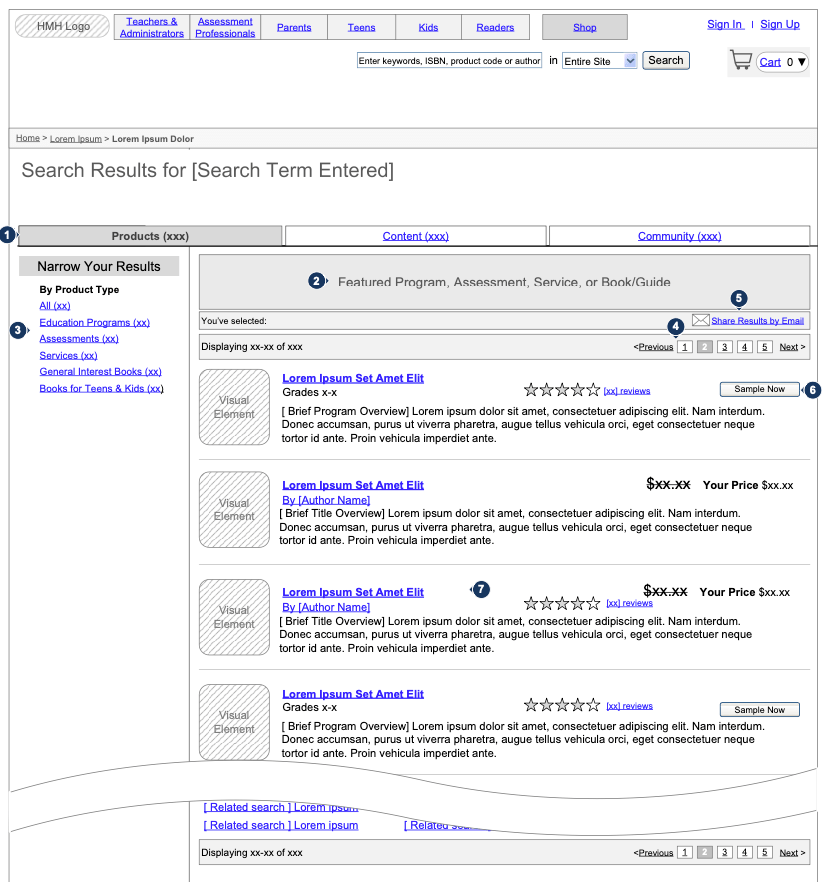
I designed a navigation framework built around how people actually approach the content: visitors first identified their user type (teacher, assessment professional, parent, teen, child, or reader), then refined by content type (product, content, or community). That two-step structure let one site serve very different audiences without forcing them all down the same path.
Challenge
Naming the non-academic visitor type became the most debated detail of the whole redesign. HMH sold a substantial amount of general-interest fiction alongside its educational catalog, and there wasn’t an obvious label for someone who was just there to read. I ran guerrilla research at local bookstores, talking to people browsing HMH titles outside any academic context, and recommended “Readers” — a term that fit everyone I’d talked to, not just the ones easiest to categorize.
Validation
I reviewed the new site architecture with stakeholders and educators, synthesized their feedback, and made a final round of structural updates. I ran the same process on the wireframes, building a clickable prototype so reviewers could navigate the new experience instead of reacting to static screens.
Outcome
HMH consolidated 20+ sub-brands onto one site under a single brand, cutting the number of properties they had to maintain from dozens to one.

