My Role
UX Lead for Putaway, end-to-end — from research through configuration design, partnering with product and engineering within Home Depot’s Enterprise Supply Chain program.
Problem
Inventory arriving at a distribution center has to be stored quickly and in a location that makes sense — close enough to picking areas to keep fulfillment fast, but placed by rules operations managers could actually set up and trust. The legacy WMS ran on outdated, DOS-based systems that required extensive training just to configure, and every new distribution center or new SKU meant re-doing that setup from scratch.
Research
I interviewed operations managers across multiple distribution centers to understand how putaway rules were currently created, where the pain was, and how they wished the process worked instead. Two things stood out: managers were creating far more rules than they needed because the old system couldn’t generalize a rule across similar scenarios, and none of it factored in travel distance systematically — placement decisions relied on tribal knowledge from whoever set up the DC originally, not a repeatable system.
Solution
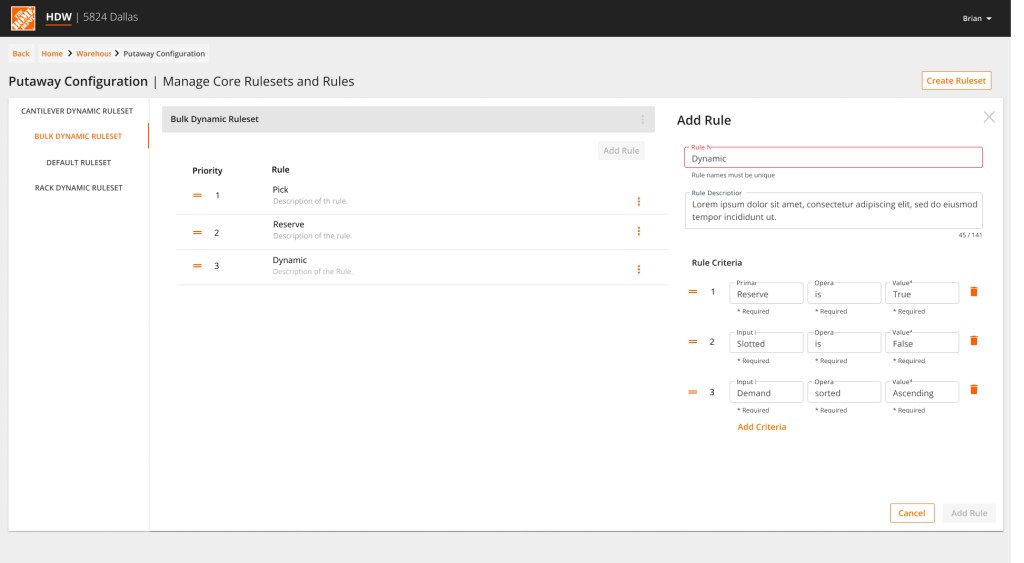
I designed a Putaway Configuration module that let operations managers create dramatically fewer rules by building in the logic the old system lacked. Underneath it, I designed a warehouse configuration tool that calculated relative travel distance between storage locations — one of the primary factors managers had been reasoning about manually — so the system could recommend and validate placement instead of requiring managers to encode every scenario by hand.
Outcomes
New distribution centers could be converted to the new WMS faster, and configuring rules for new SKUs took a fraction of the time it used to. For example, the number of rules needed to govern an inventory’s storage location was reduced by over 50%, which led to a decrease in setup time for onboarding new distribution centers. Overall warehouse efficiency improved as a direct result of inventory landing in better locations the first time.

